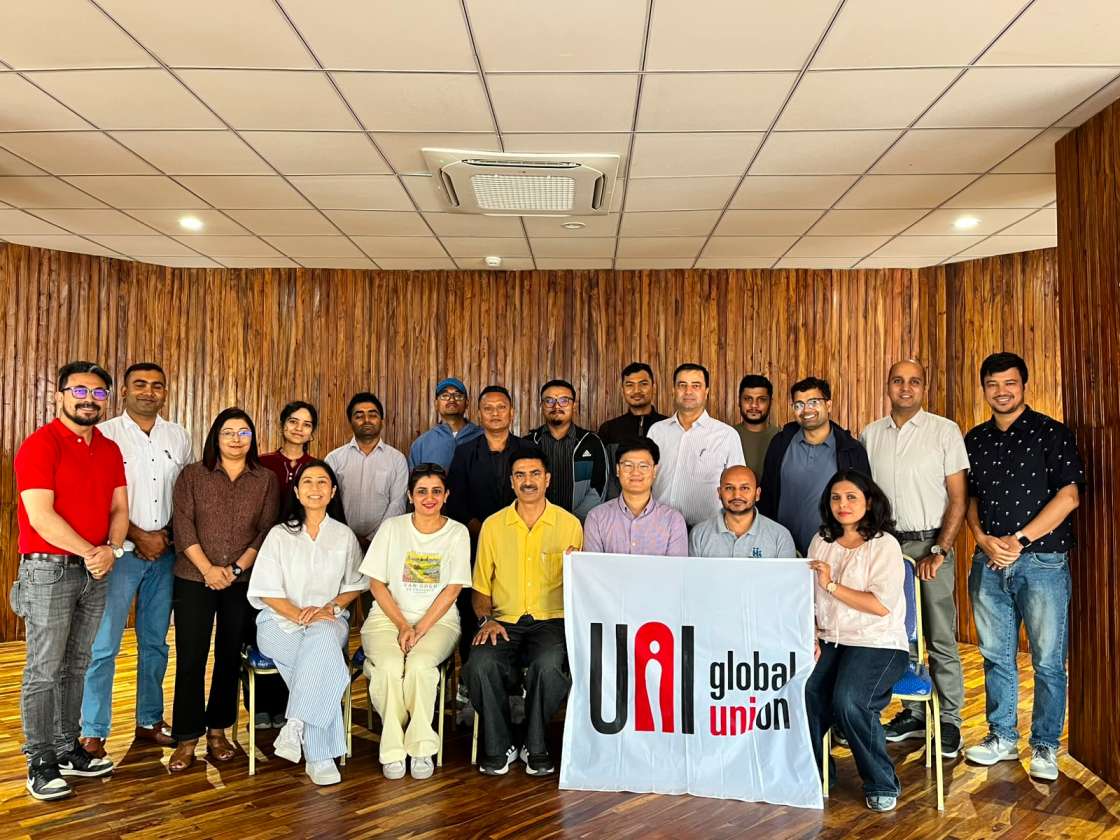

The UNI Nepal Liaison Council – Professionals & Managers Committee successfully organized an AI Workshop for Banking and Insurance Professionals on Monday at the Nepal Insurance Authority, Kupondole, Lalitpur. The workshop brought together 20 participants from Nepal’s banking and insurance sector to explore the growing role of Artificial Intelligence (AI) in the workplace and its practical applications in the financial industry.
The workshop featured Bijay Rai, former IT Expert at the Secretariat to the Minister of Communication and Information Technology, Government of Nepal, as the resource person. Drawing on his extensive experience in digital transformation, innovation, and emerging technologies, Rai conducted an engaging session demonstrating how AI can enhance workplace productivity, improve decision-making, and support professionals in their day-to-day responsibilities.
The program was chaired by Purna Bahadur Thapa, President of the UNI Nepal Professionals & Managers Committee, while Abhash Adhikari, Secretary of the Committee, coordinated the event.
The event was attended by distinguished guests including Padamraj Regmi from Nepal Rastra Bank, Bikash Shrestha, General Secretary of FEUN, and Bandana Sharma and Palpasa Tuladhar from the UNI APRO Professionals & Managers Committee.
Addressing the participants, Padamraj Regmi appreciated the initiative of the UNI Nepal Professionals & Managers Committee for organizing a timely workshop focused on Artificial Intelligence. He highlighted the important role played by UNI in promoting professional development, knowledge sharing, and capacity building among professionals. He also noted that as Nepal’s banking and financial sector continues to embrace digital transformation, professionals must continuously upgrade their skills and adapt to emerging technologies to remain relevant and effective in their workplaces.
Speaking at the program, Bikash Shrestha emphasized that trade unions have a broader responsibility beyond safeguarding workers’ rights. He stated that trade unions should also focus on developing the knowledge and skills of their members to prepare them for the changing world of work. Highlighting the growing influence of Artificial Intelligence across industries, he encouraged professionals to embrace technological change, enhance digital literacy, and view AI as an opportunity to improve productivity and service delivery rather than as a challenge.
Representing the UNI APRO Professionals & Managers Committee, Bandana Sharma and Palpasa Tuladhar congratulated the organizers for successfully conducting the workshop. They emphasized that digital transformation and Artificial Intelligence are rapidly reshaping workplaces across the Asia-Pacific region and stressed the importance of continuous learning and collaboration among professionals. They also reaffirmed UNI APRO’s commitment to supporting initiatives that strengthen the capacity of professionals and prepare them for future workplace challenges.
The interactive workshop encouraged participants to exchange ideas, discuss emerging trends, and gain practical insights into the use of AI in the banking and insurance sector. Participants actively engaged with the resource person throughout the session, making the program informative and highly interactive.
In his closing remarks, Purna Bahadur Thapa thanked the distinguished guests, resource person, participants, and supporting organizations for contributing to the success of the event. He reaffirmed the commitment of the UNI Nepal Professionals & Managers Committee to organizing more professional development and capacity-building programs that equip members with the knowledge and skills needed to thrive in an increasingly digital workplace.
The workshop concluded with positive feedback from participants, who appreciated the practical learning experience and expressed interest in attending similar programs on Artificial Intelligence, digital transformation, and emerging technologies in the future.